
Guts on a handset — full lobby, live floor, cashier, verification uploads, and round-the-clock chat, all through Safari or Chrome. Nothing installs, because no app exists for any market. Ontario players cannot open an account at all.
Responsive delivery across iOS and Android, with a home-screen shortcut approximating installed behaviour on one tap. Reach more than 2,000 slots from 45 studios — NetEnt, Play'n GO, Pragmatic, Evolution, Nolimit City, Big Time Gaming, Hacksaw, Yggdrasil, Red Tiger, Quickspin and dozens besides — alongside a streamed floor covering roulette, blackjack, baccarat, dice and game-show formats, plus the Mega Moolah progressive network.
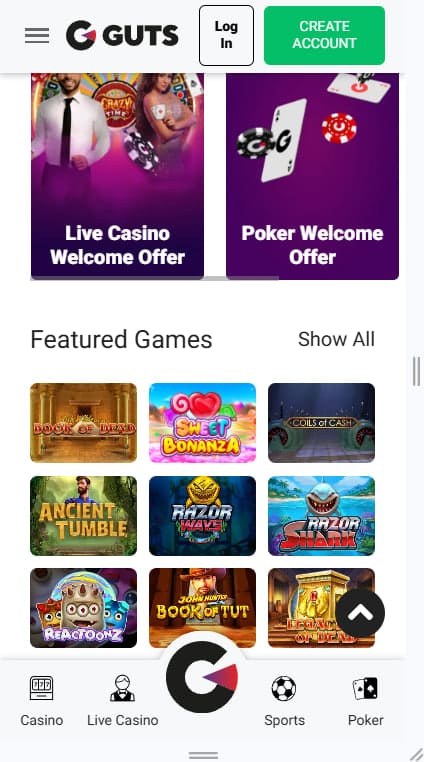
Handset access at this brand runs one way — the responsive lobby opened inside Safari, Chrome, or any modern smartphone browser. Nothing installs, and nothing is meant to. The operator describes its platform as optimised for mobile across a broad range of iOS and Android devices, delivering the same lobby a desktop session gets.
Unlike most brands where the missing download generates confusion, here the picture is unusually clean: no marketplace anywhere carries a Guts app, so there is no lookalike listing to mistake for the real thing. What does generate confusion is a well-established Canadian review page that lists the absent app among its drawbacks, then praises the mobile browser site a few paragraphs later. Both claims sit on one URL. We will untangle that below.
Coverage runs through practical workflow: reaching the lobby, pinning a shortcut, what shifts against desktop, how the cashier and verification behave on a small display, and where mobile genuinely falls short. Everything reflects what the operator and independent assessors publish about the platform.
| Access Path | Mechanics | Who It Suits |
|---|---|---|
| 🌐 Direct browser session | Open Safari or Chrome, type the address, sign in — nothing downloads, no storage consumed | Occasional visitors, anyone testing before committing, players sharing a device |
| 🏠 Home-screen shortcut | Bookmark through the share menu; one tap lands you in a dedicated tab | Regular accounts wanting quick entry without installing anything |
| 🚫 Store download | Does not exist — no marketplace carries software from this brand for any market | Nobody, despite what one Canadian page implies |
Straightforward answer: the operator never built one, and the reason is structural rather than lazy.
Apple and Google both restrict real-money gambling distribution heavily, requiring market-specific licensing before an app reaches a store listing. Brands serving Canada from an offshore permit generally cannot clear that bar, so the browser becomes the delivery channel by default. Roughly every venue in this category makes the same choice.
What Guts gains from skipping it: no update cycle to manage, no storage footprint, no gap between what desktop users see and what handset users get. Sessions load the current build every time because there is no older version cached on a device somewhere.
Worth noting for anyone tempted by shortcuts: since no legitimate package exists anywhere, any site offering an installable file for this brand is offering something the operator did not make. That is not a grey area or a regional workaround — it is an unknown binary requesting permissions on a device that holds your banking apps, while you type casino credentials into it. A bookmark reaches the identical lobby at zero risk.
A Canadian domain with genuine authority — media citations, industry awards, the full apparatus — publishes a Guts review listing "No mobile version available" among its cons. Same page, further down: the venue "has a pretty excellent mobile browser site that offers up all of the main features," fully scalable, compatible with Android and iOS alike.
Those cannot both be true. The second is accurate; the first appears to be an editing artefact that has survived roughly fourteen months without anybody catching it. We flag it because that page ranks, readers see the cons box first, and a factual error about whether a product works on phones is not a small thing on a query where most traffic arrives from phones.
Behaviour approximates a real application closely enough that most people stop noticing the difference within a week. One distinction matters: iOS treats the shortcut as a bookmark, so login persistence follows Safari's rules, and clearing browsing data signs you out.
Android handles this marginally better. Where Chrome detects the right markers, your shortcut receives its own task-switcher entry rather than living inside a browser tab — which brings the experience closer to native. Storage occupied remains negligible either way.
Practically everything. We could not identify an account function that desktop offers and handsets do not.
| Aspect | Handset Behaviour | Larger Screen |
|---|---|---|
| 📐 Lobby density | Category tiles stack vertically; scrolling replaces scanning | Grid layout surfaces far more titles per screen |
| 🔍 Finding a game | Search carries most of the load across a 2,000-title library | Category and provider filters sit visible without tapping into menus |
| 🎥 Live tables | Single-table focus; side bets occupy overlays covering the stream | Multi-table views and persistent bet panels stay workable |
| 📄 Reading terms | Legible but tedious — and with three competing wagering figures circulating, the terms are worth reading properly | Considerably easier when checking rollover against game weighting |
| 📸 Verification | Camera capture beats scanning and transferring files | Requires photographing documents separately, then moving them across |
Verification is where phones genuinely win. Given that document handling draws the sharpest criticism attached to this venue — formatting requirements described as rigid, valid papers rejected repeatedly — capturing identification directly through a camera removes an entire failure mode that scanning introduces.
Signup runs through the Create Account button and a short form. The operator promises two minutes; that seems about right for a handset if you have your details ready.
Read the offer on screen carefully rather than trusting anything you saw elsewhere. Accessible sources publish the Canadian welcome bonus as C$200, C$500, C$1,000, and a three-deposit structure reaching $1,500 — five-fold disagreement. Your cashier shows the only version that binds anybody.
Ontario residents will not get past this stage at all. The operator states directly that Guts does not operate in the province.
Funding works cleanly from a phone. Interac and Interac e-Transfer both appear, alongside cards, wallets, and vouchers. Deposits start at C$10 and credit immediately.
Payouts begin at C$20 on most routes and pass through an approval window before reaching your provider. Here sits the brand's strongest feature, and it works identically on mobile: no withdrawal cap exists. Not a high ceiling — none, across all nine supported currencies including Canadian dollars, with no win limit either. Requesting C$40,000 from a phone involves the same three taps as requesting C$40.
Speed varies. One player reported Visa payouts landing inside forty minutes. Interac draws criticism specifically for weekend slowness relative to the marketing. Verification status matters more than method — a verified account moves fast on any rail, an unverified one moves nowhere on all of them.
Three honest criticisms.
Language. The website ships in English and Norwegian; support and chat run in English alone. On a handset that bites harder than on desktop, because a phone session is where you reach for chat rather than composing an email. Francophone players in Québec — a province this venue explicitly accepts — get no French interface, no French chat, and at least one public report of French-language documents being refused during verification.
Session persistence cuts both ways. A pinned shortcut keeps you signed into a funded gambling account on a device that travels in a pocket. Anyone sharing a phone with family should use the browser directly rather than leaving an icon that opens a live balance on one tap. Treat your device passcode as the security layer, because it may be the only one.
Terms are hard to audit on a small screen. Ordinarily a minor gripe. Here it matters: with 25×, 35×, and 40× all circulating as the rollover figure, and live tables contributing only 15%, reading the actual terms is not optional — and doing it on a phone is genuinely unpleasant.
Slots cost little. Animation renders locally once assets load, so an hour of spinning consumes less than most video apps.
Live tables invert that entirely. Dealer content is continuous video streamed from a studio, and an extended session on cellular will register on both a battery meter and a monthly allowance. The operator emphasises multiple camera angles and HD delivery, which look excellent and cost bandwidth accordingly. Wi-Fi is the sensible default whenever a croupier appears on screen.
Small note for demo play: free mode loads the same assets as real money. Auditioning twenty titles over cellular before depositing carries a real, if modest, cost. Doing it at home carries none.
Tooling is reasonably complete on paper — deposit limits, session limits, loss limits, self-exclusion, reality checks, and cool-off periods all appear across the operator's own material and independent assessment.
Access is the reservation. The operator's guidance directs players to contact customer support to set account limits, framing its agents as available around the clock to help. Willingness is not the issue; friction is. Somebody deciding at 2am that tonight should end needs a toggle, not a conversation — and on a phone, opening a chat window and explaining yourself to a stranger is exactly the barrier that stops people from following through.
Partnerships with GamCare and Gamblers Anonymous get named. Canadian readers whose play is causing harm should contact ConnexOntario at 1-866-531-2600 or reach the Responsible Gambling Council — both independent of any operator, both reachable from the same handset.
One correction worth repeating on every page: the operator states 18 as the minimum age "in Canada." Nineteen applies across most provinces, with 18 limited to Alberta, Manitoba, and Quebec.
Browser-first delivery costs Canadians almost nothing here. Full catalogue, full cashier, full verification, live floor, round-the-clock chat — nothing withheld, no storage used, no update cycle. The venue's best feature travels perfectly: uncapped withdrawals work the same from a phone as from a desk.
Real weaknesses have little to do with screen size. English-only support hurts a fifth of the country. Responsible-gambling controls sitting behind a support conversation is a design decision we would push back on anywhere. Neither is a mobile problem — both are product problems that a small display makes more visible.
Practical advice: pin a shortcut if you play often, keep live tables on Wi-Fi, verify through the camera during your first session rather than your first withdrawal, read the cashier's real offer instead of trusting any review including this one, and ignore any site offering an installable file. That last point is the only genuinely dangerous mistake available.
No — not for Canada, not for any market. Apple and Google restrict real-money gambling distribution to licensed operators in specific jurisdictions, and offshore brands serving Canadians generally cannot meet that requirement. Browser play delivers the complete lobby instead, and a home-screen shortcut gets you most of the way to app behaviour.
An editing error that has gone uncorrected for around fourteen months. The page in question lists the missing app among its cons, then describes the mobile browser site as excellent and fully compatible with Android and iOS a few paragraphs down. Take the second statement — the responsive site works.
Absolutely not. Since the operator publishes no legitimate package anywhere, anything circulating under that name was built by somebody else entirely. It is an unverified binary asking for device permissions while you enter gambling credentials beside your banking software. No functionality justifies that, particularly when a bookmark reaches the identical lobby.
Yes. Over 2,000 slots from 45 studios, live dealer rooms, table games, jackpots including Mega Moolah — nothing gets held back for desktop. Play-money mode works too, letting you test any title without an account or a deposit.
You can, and it is the better method. Photograph documents directly rather than scanning and transferring — full frame, daylight, corners visible. Given that document formatting draws the sharpest criticism attached to this venue, removing a transfer step removes a failure point.
Yes, and this is the venue's standout feature. Payouts carry no cap in any of the nine supported currencies, Canadian dollars included, with no win limit either. The request flow is identical regardless of amount. Minimum sits at C$20 on most routes.
No. The website ships in English and Norwegian only, and support operates in English alone. Québec appears on the accepted-provinces list regardless. One Canadian player has publicly reported French-language legal documents being refused during verification, which francophone readers should weigh before depositing.
Considerably more than slots, since dealer content is continuous video rather than locally rendered animation. Extended cellular sessions will show on a monthly allowance. Slots cost little once assets load. Wi-Fi makes sense whenever a croupier is on screen.
Through customer support rather than a self-service toggle — the operator directs players to contact its agents, who are available around the clock. Tools include deposit limits, session limits, loss limits, reality checks, cool-off periods, and self-exclusion. We consider the routing a genuine shortcoming; anyone needing an immediate stop should also look at ConnexOntario on 1-866-531-2600.
Barely, in practice. Nothing meaningful occupies storage, no permissions get requested, and your session behaves as the browser manages it — meaning cleared browsing data signs you out. Android sometimes grants the shortcut its own task-switcher entry, which feels closer to native than iOS manages.